How to Use ESL Conversation Mazes to Build Speaking Confidence in Your Classroom
If you’ve ever asked your English learners to “turn and talk” only to be met with silence, one-word answers, or nervous smiles, you’re not alone.
Many multilingual learners know more English than they feel confident using. The challenge isn’t always vocabulary or grammar, but often having a structured and supportive opportunity to practice speaking.
That’s why conversation mazes have become one of my favorite speaking activities for the ESL classroom.
Conversation mazes transform traditional speaking practice into an engaging, game-like experience that encourages every student to participate. As students move through the maze, they follow a path of carefully designed questions and prompts that guide meaningful conversations with their classmates.
Instead of struggling to think of what to say next, students receive built-in language support that helps them stay engaged in the conversation. This structured approach reduces speaking anxiety, increases participation, and helps learners build confidence one conversation at a time.
WHAT IS A CONVERSATION MAZE?
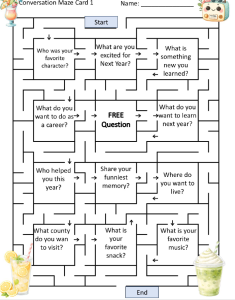
A conversation maze is an interactive speaking activity where students move through a maze by asking and answering questions as they arrive to each room.
As students travel through the maze, they stop at different conversation prompts and practice speaking with a partner. Each speech bubble or checkpoint contains a question designed to encourage oral language development.
Questions may focus on:
- Personal experiences
- Opinions
- Favorites
- Descriptions
- Future plans
- Classroom topics
- Seasonal themes
The goal isn’t to find the fastest route. The goal is to create multiple opportunities for students to speak, listen, and interact using English.
HOW TO USE IT
Step 1: Introduce the Conversation Questions
Before beginning, review the conversation prompts and any new vocabulary with students.
For beginner learners, model answers and discuss unfamiliar vocabulary.
Step 2: Pair Students
Assign students a speaking partner.
Encourage students to take turns asking and answering each question they encounter.
Step 3: Follow the Maze Path
Students trace their way through the maze.
Each time they reach a speech bubble, they stop and discuss the question before continuing.
Step 4: Encourage Complete Sentences
Provide sentence stems when needed.
Examples:
- My favorite ______ is ______.
- I like ______ because ______.
- This summer I want to ______.
Step 5: Reflect and Share
After completing the maze, invite students to share something they learned about their partner.
This adds an additional layer of listening and speaking practice.
If you’re curious about what a conversation maze looks like – check it out 👇
WHY IT WORKS
Conversation mazes combine several research-based language supports into one simple activity. Students always know what to talk about next, reducing anxiety and hesitation. Students practice speaking multiple times throughout the activity instead of answering only one question. It helps to create a low stress environment for speaking in a small group. It encourages authentic communication between peers, and it feels more like a game rather than a traditional speaking assignment.
BENEFITS
Conversation mazes help students:
✓ Build speaking confidence
✓ Practice listening skills
✓ Develop conversational language
✓ Strengthen peer relationships
✓ Increase classroom participation
✓ Use academic and social language
✓ Improve fluency through repetition
✓ Stay engaged through movement and interaction
✓ Practice complete sentence responses
✓ Reduce speaking anxiety
WHEN TO USE IT
Conversation mazes work well throughout the school year.
Try using them during:
- Back-to-school activities
- Morning meetings
- Speaking centers
- Small-group instruction
- Fast finisher activities
- End-of-year celebrations
- Holiday-themed lessons
- Community-building activities
- ESL pull-out groups
- Summer school programs
They are especially effective when students need structured opportunities to practice oral language.
TIPS FOR SUCCESS
Differentiate Question Levels
I always include a mix of simple and open-ended questions to support learners at different proficiency levels. I try to avoid yes – no questions as best as I can. This way students can practice using target vocabulary they have learned during the lesson.
Provide Sentence Stems
I offer simple language supports such as sentence stems to help the student with starting their conversations. However, I am careful to also not provide all sentence stems or language frames needed for the activity. I want to make sure the students are able to use “their own English” during the lesson.
Other Tips for Getting Started
Demonstrate a sample conversation before students begin.
Challenge students to ask one additional question after answering.
Focus on participation and effort rather than perfect grammar.
The goal is confidence and communication.
COMMON MISTAKES TO AVOID
Asking Questions That Are Too Difficult
Questions should match students’ language proficiency levels. Pre-teaching important vocabulary helps students participate more successfully. Give students enough time to actually talk. The conversations are more important than finishing the maze. We all know the difficulty of uncomfortable silence in the classroom, but remember, that doesn’t mean students are not thinking or processing the language.
FINAL THOUGHTS
Speaking confidence develops through practice, not perfection.
Conversation mazes provide students with a structured, engaging, and low-pressure way to use English while building meaningful connections with classmates.
Whether you’re teaching newcomers or developing multilingual learners, this simple activity can transform speaking practice from something students avoid into something they genuinely enjoy.
Sometimes the best language growth happens when students are simply having a conversation.
Are you looking to try an engaging way for your Multilingual Learners to practice Speaking in a fun and engaging way?
My ESL Conversation Maze Activities are designed specifically for beginner and intermediate multilingual learners and include engaging speaking prompts, student-friendly layouts, and low-prep activities that make oral language practice fun and meaningful.
Click the Link Here to try it for your class
 Skip to content